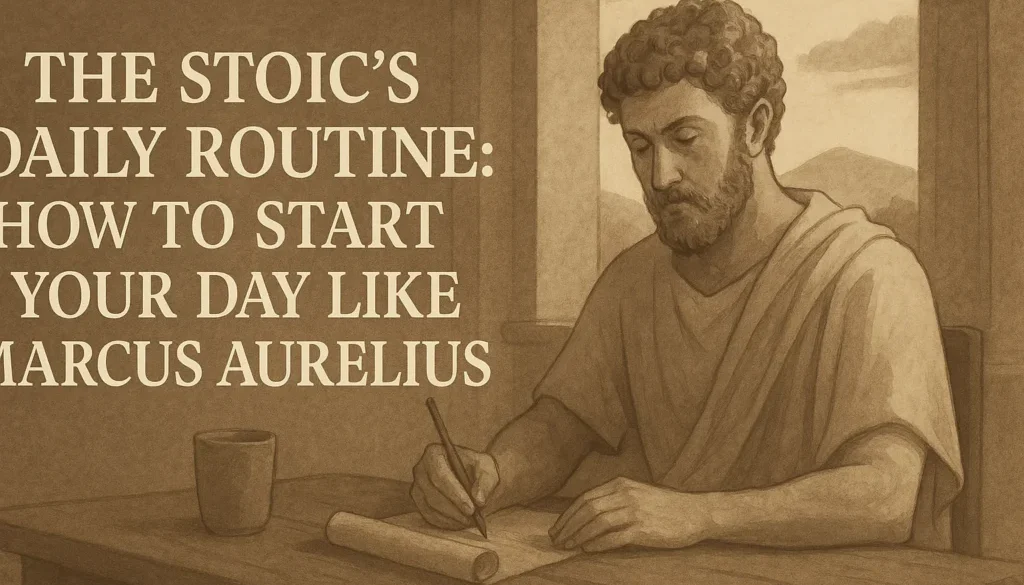
The Stoic’s Daily Routine: How to Start Your Day Like Marcus Aurelius
Marcus Aurelius – As the philosopher and emperor of Rome during the peak of its power Marcus Aurelius faced war alongside plague and betrayal and personal tragedies yet he remained steadfast through an unshakeable Stoic daily practice. He maintained his unwavering commitment to Stoicism through every challenge that life presented him.
His private journal Meditations existed only as a personal manual that Marcus did not intend to share with others. Meditations served as his private handbook for self-control and it contained instructions on how to lead a life of virtue with focus and resilience.
Two thousand years later, his wisdom remains startlingly relevant.
In this guide, we’ll break down the complete Stoic daily routine inspired by Marcus Aurelius, adapted for modern life. You’ll learn:
– The exact morning ritual that fortified his mind before facing the chaos of ruling an empire
– How he structured his workday to maintain focus amid endless distractions (yes, even ancient Rome had them)
– The Stoic evening review—a powerful journaling practice to end the day with wisdom
– Physical and mental resilience tactics that kept him sharp despite chronic illness and stress
– Hidden lessons from his struggles—how to handle criticism, loss, and uncertainty like a Stoic
This isn’t just history. It’s a blueprint for mastering your time, energy, and attention in a distracted world.
Let’s begin.
I. The Stoic Morning: Building an Unbreakable Mind (Before the World Breaks You)
1. Wake Like a Roman: The 5-Second Discipline
Marcus didn’t have alarms. He had self-command.
His journal reveals a brutal morning mantra:
“At dawn, when you have trouble getting out of bed, tell yourself: ‘I have to go to work as a human being. What’s the point of existing if I don’t?’”
Why this matters today:
Most people surrender their first waking moments to their phones—letting external demands set the tone for the day. Marcus took control immediately.
How to do it:
– The 5-Second Rule (Modern Stoic Version): When your alarm rings, count backward 5-4-3-2-1 and rise without debate. No snoozing.
– No Digital Noise: Avoid checking email or social media for at least 30 minutes. Your mind is most impressionable in the first hour—don’t pollute it.
2. Morning Meditation: The Stoic “Premeditation of Evils” (Premeditatio Malorum)
Before facing the day, Marcus would mentally rehearse challenges he might encounter:
“Begin each day by telling yourself: Today I shall meet interference, ingratitude, insolence, disloyalty, ill-will, and selfishness—all due to the offenders’ ignorance of good and evil.”
This wasn’t pessimism—it was emotional inoculation. By visualizing adversity in advance, he reduced its power to shock or derail him.
Your practice:
– Spend 5 minutes journaling: “What obstacles might I face today? How will I respond with calm and wisdom?“
– Example: If you have a stressful meeting, mentally rehearse staying composed if someone interrupts or criticizes you.
3. Philosophy as Fuel: The Morning Reading Ritual
Marcus started his day with philosophy, often reading Epictetus or Heraclitus. He didn’t skim—he engaged, underlining passages and reflecting on how to apply them.
Modern adaptation:
– Read one Stoic passage (from Meditations, Letters from a Stoic, or The Daily Stoic) and ask:
– How does this apply to my life today?
– What’s one action I can take based on this?
– Keep a commonplace book (a notebook for key insights) to revisit later.
II. The Stoic Workday: Focus Like an Emperor in a World of Distractions
4. The Antoninus Method: Time-Blocking Like a Roman
Marcus admired his predecessor, Antoninus Pius, for his meticulous focus:
“He never exhibited hurry, never procrastinated… Everything was divided into manageable parts.”
How to apply this today:
– The 90-Minute Emperor Focus Block:
– Choose your most important task.
– Set a timer for 90 minutes. No interruptions—no emails, no messages.
– Work with full presence, as if the empire depended on it.
– The “Is This Worthy?” Test: Before any task, ask: “Does this deserve my limited time and attention?” If not, eliminate or delegate it.
5. Handling Criticism Like Marcus
As emperor, Marcus faced constant scrutiny—yet he wrote:
“When another blames or hates you, it’s because they’re disturbed by their own errors. Their opinions are like barking dogs—noise, not truth.”
Stoic feedback framework:
– If criticism is true → Learn from it.
– If it’s false → Let it go.
– If it’s malicious → Pity their ignorance, then move on.
Try this: Once a week, ask a trusted colleague or friend: “What’s one thing I could improve?” Then journal your response without defensiveness.
III. The Stoic Evening: Reflection, Release, and Preparing for Tomorrow
6. The Stoic Journaling Ritual (The Evening Review)
Marcus ended each day with self-reflection:
“Ask yourself: What did I do well? Where did I fail? What did I avoid doing? What must I improve tomorrow?”
Your practice:
– The 3-Question Stoic Journal:
1. What virtue did I practice today? (Courage? Patience?)
2. Where did I act against my principles?
3. What’s one small improvement for tomorrow?
– Memento Mori Reminder: “You could leave life tonight. Did you spend today wisely?”
7. The Digital Sunset (How Marcus Would Detox from Screens)
While Marcus didn’t have Netflix, he warned against mental dissipation—frittering away energy on trivialities.
Modern Stoic wind-down:
– No screens 1 hour before bed. Instead:
– Read philosophy or literature.
– Take a mindful walk (no headphones).
– Practice gratitude: List 3 things you’re thankful for.
IV. The Hidden Pillars of Marcus’ Resilience
8. Physical Training: The Stoic Body-Mind Connection
Despite chronic illness, Marcus trained in boxing, wrestling, and horseback riding—not for vanity, but for discipline.
Modern equivalents:
– Daily movement (even 20 minutes of walking).
– Cold exposure (30-second cold showers to build willpower).
– Posture practice (Marcus stood straight as a ruler—a sign of self-respect).
9. The Stoic Social Diet: Guarding Your Mind from Toxins
Marcus warned:
“The people you spend time with will shape who you become. Be ruthless in curating your inner circle.”
Action step:
– Audit your influences:
– Who drains your energy? Limit exposure.
– Who inspires virtue? Seek them out.
V. The Ultimate Stoic Question: “Is This How I Want to Spend My Life?”
Marcus’ greatest lesson wasn’t about routines—it was about urgency:
“You could leave life right now. Let that determine what you do, say, and think.”
Final challenge:
1. Set a daily reminder: “Is this how I want to spend my limited time?”
2. At week’s end, review: Did I live by my principles, or was I swept by distraction?
Conclusion: Your Invitation to Stoic Mastery
Marcus Aurelius didn’t have a perfect life. He had a practiced life—one where discipline, reflection, and virtue were daily choices.
Your Stoic Action Plan:
– Morning: Wake with purpose → Read philosophy → Premeditate challenges.
– Workday: Block focus time → Filter distractions → Accept feedback calmly.
– Evening: Journal → Detox from noise → Prepare for tomorrow.
As Marcus wrote:
“Waste no more time arguing what a good man should be. Be one.”
The sun is rising. How will you meet the day?
P.S. If this resonated, share it with one person who needs Stoic wisdom. Then—close this tab, and act.
Related Posts


October 31, 2025 @ 9:35 pm
It is best to participate in a contest for among the best blogs on the web. I will advocate this web site!