
The Mirror That Reflects More Than Your Face: How This Simple Practice Builds Unshakable Confidence
The Uncomfortable First Encounter: Meeting Your True Self
There’s a strange, powerful moment that happens the first time you truly stand in front of a mirror and speak to yourself. Your eyes lock with the person staring back at you, your voice echoes slightly in the quiet room—and suddenly, you meet you. Not the carefully curated version you present to the world, but the person who hides behind hesitation, fear, and self-doubt.
This initial discomfort is where transformation begins. When one woman named Jen practiced for job interviews in front of her bathroom mirror, she initially broke into giggles or mentally beat herself up for her grammar and responses. Yet after three weeks of consistent practice, she faced an actual interview panel with greater confidence than ever before and successfully landed the job. This is the power of mirror work—it isn’t about narcissism, but about honest self-confrontation that leads to growth.
What Mirror Work Really Teaches You: Beyond Surface-Level Flaws
The first thing mirror work reveals isn’t perfection—it’s flaws. When you speak to your reflection, you become acutely aware of every tiny imperfection: the uncertain pitch of your voice, the pauses that linger too long, the lack of conviction in your own words, and the body language that doesn’t match your message.
This raw confrontation is precisely where the transformation begins. As you notice these elements, improvement becomes almost natural. You start gaining genuine confidence not from pretending to be someone else, but from deeply understanding and working with your actual self. This self-awareness forms the foundation of authentic leadership—the courage to face your own reflection and commit to growth.
One executive discovered this powerfully when she watched a video of her rehearsal and was appalled to see she looked angry and unapproachable. She simply had no idea how she came across to others. The mirror gives us this immediate feedback without needing recording equipment or waiting for replay.
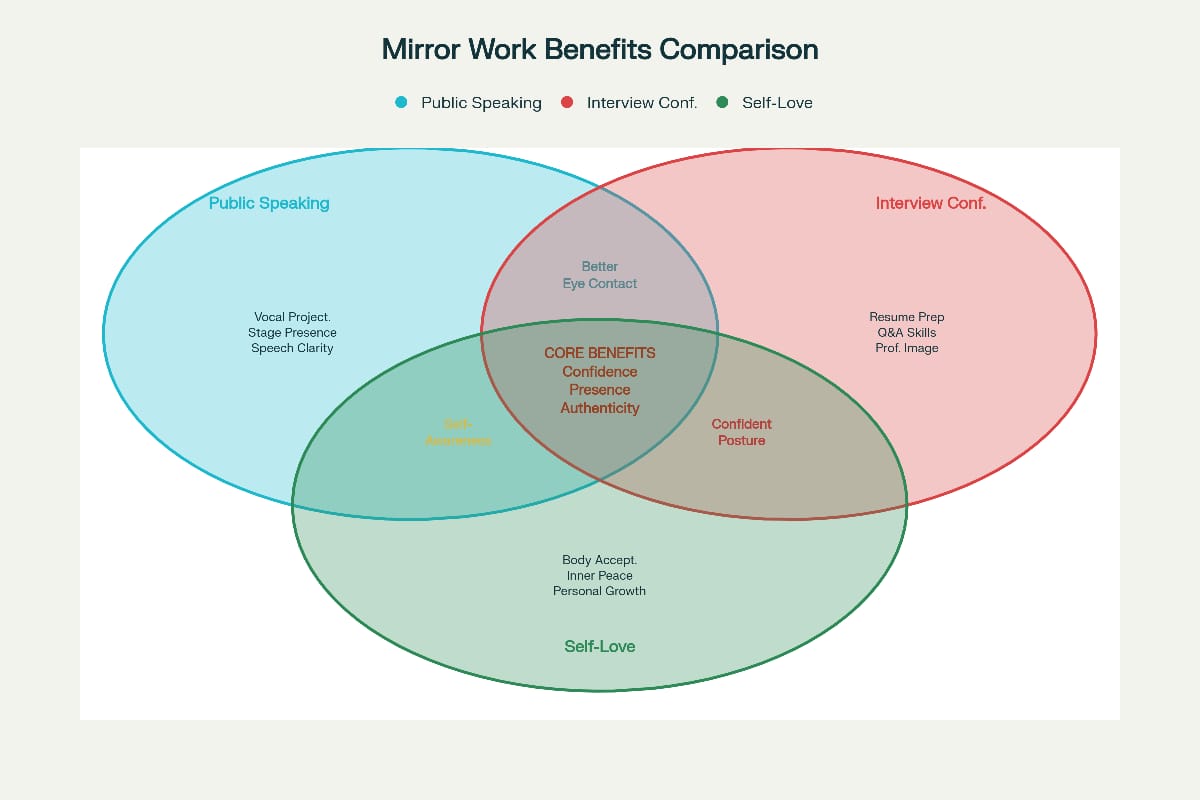
Mirror Work Outcomes: Public Speaking, Interviews, and Self-Love
The Psychology and Science Behind Mirror Work
Mirror work operates on several psychological principles that explain its effectiveness in building confidence and self-awareness.
Rewiring Your Neural Pathways
When you consistently practice positive affirmations while looking at your reflection, you’re essentially creating new neuropathways in your brain. One spiritual mentor notes that through regular mirror work, “you are building your self-esteem and confidence internally by building a solid foundation that you are growing on”. What feels unnatural at first gradually becomes your truth.
Activating Self-Compassion
A 2017 study on mirror work found it to be an effective addition to self-compassion practices, with researchers noting that “The mirror enhances the efficacy of this self-compassion manipulation in activating the soothing affect system connected with parasympathetic nervous system activity“. This means mirror work doesn’t just help psychologically—it creates measurable physiological calming effects.
The Eye Contact Connection
While practicing in front of the mirror, maintaining eye contact with yourself builds a different level of connection. It teaches you to be authentic—to speak truthfully, not perform. When your eyes don’t waver, your confidence stops wavering too. This practice translates directly to real-world interactions, helping you maintain better eye contact during conversations, presentations, and interviews.
How Mirror Work Serves Different Aspects of Your Life
Public Speaking and Presentation Skills
For public speaking, mirror practice is one of the oldest and most effective techniques. It helps you:
· See what you look like to your audience, providing immediate visual feedback
· Learn to smile naturally and become more animated, overcoming what one expert calls that “pickle-faced” look many of us carry in business settings
· Reduce overreliance on notes since you can’t look at notes while maintaining eye contact with your reflection
However, some presentation coaches caution that mirror practice has limitations. One coach notes that “speakers will probably never present to their mirror image, nor see themselves in their audience”. The key is balancing mirror work with other practice methods, like recording yourself, to ensure you’re developing connection skills alongside self-awareness.
Interview Preparation
Mirror work can be particularly powerful for interview preparation. In many organizations, interviewers work with scoring systems where they allocate points for each response. How you present yourself—not just what you say—significantly impacts these scores.
Practicing answers in front of a mirror helps you eliminate filler words like “um,” “like,” and “you know” that Jen struggled with in her early practice sessions. It also helps you develop a confident presence that makes a strong impression, whether you’re facing one interviewer or a panel.
Building Self-Love and Acceptance
Beyond practical skills, mirror work builds foundational self-love. Louise Hay, author of “Mirror Work: 21 Days to Heal Your Life,” pioneered this approach, believing that “doing mirror work is one of the most loving gifts you can give yourself”.
The practice involves gazing at yourself in the mirror while saying positive affirmations such as “I love myself,” and “I am strong”. While this can feel uncomfortable initially, this confrontation helps break through negative self-talk and conditioning.
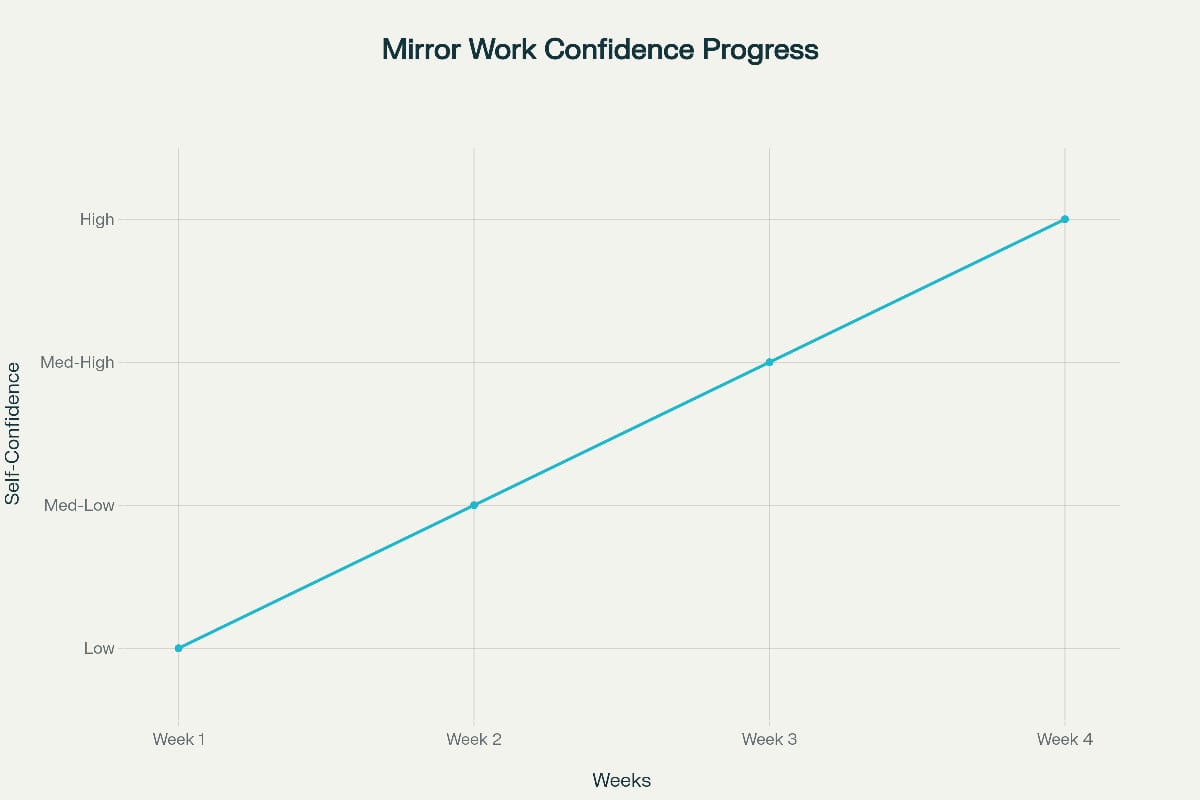
Rising Self-Confidence with Consistent Mirror Work(4 Weeks Trend)
Your Practical Guide to Effective Mirror Work
Getting Started: A Step-by-Step Approach
If you’re new to mirror work, this gradual approach will help you build comfort and consistency:
1. Start small: Begin with just 2-5 minutes daily, or even one minute if that feels more manageable. Choose a time when you won’t be disturbed.
2. Ground yourself: Before starting, do a quick breathing exercise to center yourself.
3. Hold eye contact: Gently look into your own eyes. This might feel uncomfortable at first—that’s normal. One practitioner advises: “Be kind during the practice and try not to judge yourself; instead, simply observe”.
4. Use affirmations: Say positive affirmations aloud while maintaining eye contact. Choose phrases that resonate with you personally. Some examples include:
· “I believe in myself”
· “I am enough”
· “My potential is unlimited”
· “I am confident”
· “I choose to be happy and love myself”
Advanced Mirror Work Techniques
Once you’re comfortable with the basics, these approaches can deepen your practice:
· The Morning Mirror Hack: One language learner developed a technique where he stands before the mirror first thing in the morning and holds a conversation with himself in the language he’s learning for just five minutes daily. This builds confidence in expressing himself authentically in the target language.
· Incorporate movement: Practice gestures and body language that support your message. Notice how natural movements enhance your communication versus forced gestures.
· Try full-length mirror work: If you typically use a bathroom mirror, graduate to a full-length mirror to become aware of your entire presence. Some practitioners even recommend doing this naked to fully embrace and accept yourself.
· Ritualize your practice: Create a comforting environment by lighting incense or putting on gentle background music. Making your practice a ritual deepens its impact.
Historical and Contemporary Thinkers Who Used Mirror Work
Swami Vivekananda
The influential spiritual teacher often practiced speeches aloud before mirrors to perfect his delivery and strengthen self-belief. His famous statement, “You cannot believe in God until you believe in yourself,” reflects the core philosophy behind mirror work—building foundational self-trust.
Muhammad Ali
The legendary boxer regularly practiced affirmations and speeches in front of the mirror, famously repeating: “I am the greatest.” He wasn’t merely bragging—he was programming his mind for success, using the mirror as a tool to embody the confidence he wanted to project.
Louise Hay
The author of “Mirror Work: 21 Days to Heal Your Life” popularized the modern version of this technique. She wrote, “The mirror reflects back the feelings you have about yourself,” and designed specific practices to help people transform their self-perception.
Each of these figures used the mirror not as a vanity tool but as a spiritual and psychological instrument—to know themselves, build courage, and lead others.
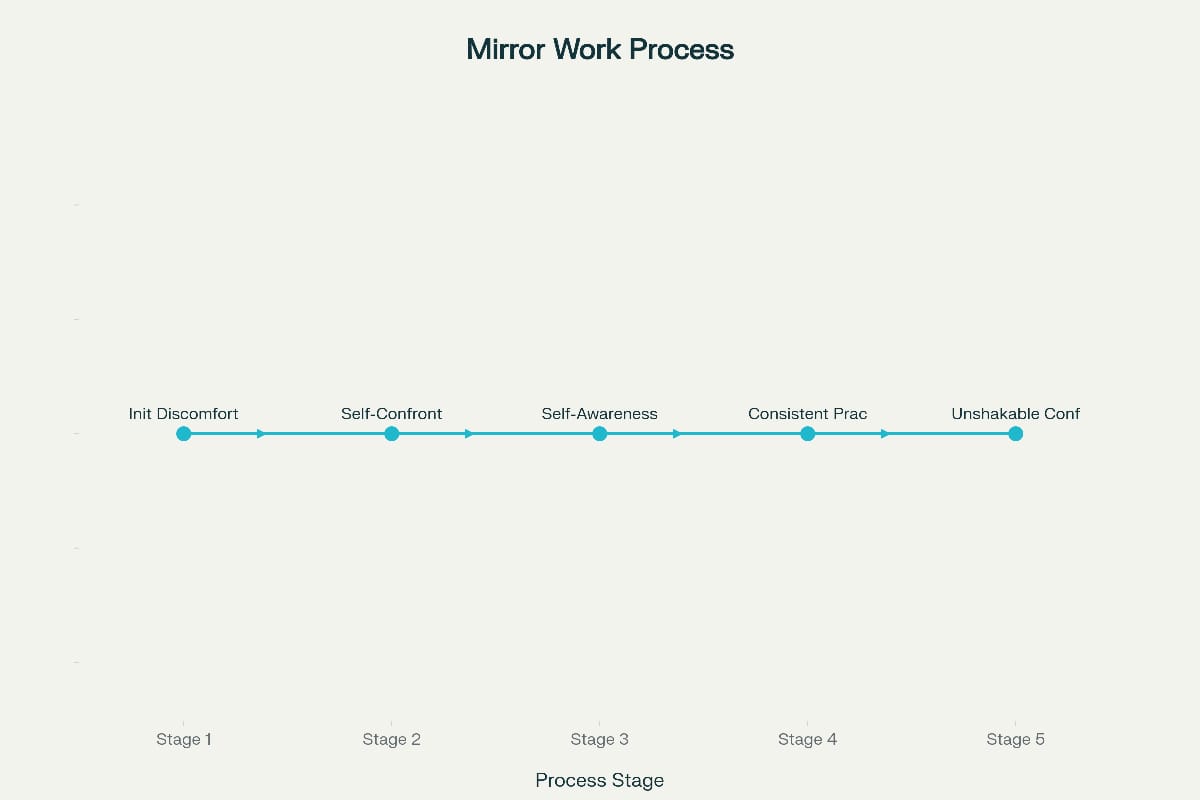
Psychological Process of Mirror Work: From Discomfort to Confidence
Overcoming Common Mirror Work Challenges
Dealing with Discomfort
If you feel uncomfortable at first, that’s normal and actually indicates you’re confronting truth rather than avoiding it. The discomfort means you’re pushing against old patterns and limiting beliefs. One practitioner confirms that while it felt weird initially, after a couple of weeks it became second nature and she began to believe her affirmations.
When Your Inner Critic Speaks Loudly
If your inner critic becomes particularly vocal during mirror work, try these approaches:
· Acknowledge the criticism without judgment
· Return to your breath and begin again
· Modify your affirmations to feel more authentic if needed
· Remember that the critic is just a conditioned voice, not truth
Maintaining Consistency
Like any transformative practice, mirror work requires consistency to produce lasting results. Setting a regular time, using reminders, and starting with very short sessions can help build the habit. Many people find morning practice most effective as it sets a positive tone for the entire day.
Mirror Work in the Digital Age: Adapting to Modern Communication
While traditional mirror work remains powerful, today’s communication landscape requires some adaptations:
Virtual Communication Practice
For Zoom, Skype, and other video platforms, mirror work can help you become comfortable with on-camera presence. One presentation coach who initially opposed mirror practice conceded that for virtual communications, “mirror feedback may have some merit”.
Social Media and Self-Image
In an era of curated digital identities, mirror work provides an antidote—an opportunity to connect with your authentic self beyond filters and performance. It helps develop confidence rooted in self-acceptance rather than external validation.
The Transformation: What to Expect Over Time
Mirror work changes you quietly but profoundly. It sharpens your awareness of both your strengths and growth areas. It builds clarity in your communication and thinking. Perhaps most importantly, you stop pretending to be confident because you gradually become confident.
With consistent practice, you’ll notice:
· Improved eye contact in real conversations
· Greater awareness of your body language
· Reduced use of filler words
· More authentic and compelling storytelling
· Increased comfort with silence and pauses
· Stronger connection to your core message and values
This transformation occurs not because someone trained you, but because you trained yourself—showing up consistently for honest self-reflection and growth.
Your Mirror Work Journey Begins Now
Mirror work is not about vanity—it’s about radical honesty. It’s about facing your truest self and preparing that person to lead, speak, and inspire others. The mirror becomes what one practitioner calls a “trusted confidant in your self-love journey” rather than just a tool for checking your appearance.
The incredible accessibility of this practice is part of its power. As one expert notes, “Unlike many routes to internal growth, you don’t need to invest copious amounts of money or even your time to use this approach”. You need only a mirror, a few minutes, and the courage to meet your own gaze.
If you can confidently speak to your reflection, you can speak to the world. The person who emerges from consistent mirror work is more self-aware, more communicative, and more authentically powerful—not because they’ve become someone else, but because they’ve finally become fully themselves.
Frequently Asked Questions (FAQs)
Mirror work involves deliberately facing oneself in a mirror while practicing affirmations, emotional reflection, or self-observation. By acknowledging and accepting your feelings and appearance, the practice activates mirror neurons and improves self-awareness, which leads to increased self-confidence over time.
Begin with 2-5 minutes in a quiet space where you won’t be disturbed. Make gentle eye contact with your reflection, breathe deeply, and speak positive affirmations aloud, such as “I am enough” or “I am confident.” Increase the session duration gradually as you get more comfortable, and consider writing down your reflections in a journal.
Initial discomfort is common because the practice exposes negative patterns and self-judgment. Overcome this by practicing kindness instead of criticism and observing your feelings without judgment. Consistency and gentleness make the experience more natural over time.
Mirror work taps into embodied cognition and activates mirror neurons, promoting emotional regulation and self-reflection. The brain’s feedback system also helps align internal feelings with external expression, which enhances self-acceptance and confidence.
Evidence shows that mirror work increases self-awareness, reduces anxiety, and refines verbal and non-verbal communication skills. This boost in confidence and articulation helps in public speaking and interview scenarios.
Yes. Research confirms that mirror work enhances self-compassion, emotional resilience, and even physiological calming effects. Experiments also show benefits for body acceptance and reducing negative self-talk.
Most practitioners begin noticing subtle shifts in self-confidence and mindset within a few weeks of regular practice. Full transformation varies by individual, typically ranging from days to months based on consistency.
Absolutely. Repeating affirmations and facing your own reflection disrupts negative thinking and cultivates self-kindness, which has proven effects in lowering anxiety and fostering self-compassion.
Louise Hay popularized modern mirror work as a method for healing and self-love. Swami Vivekananda and Muhammad Ali also practiced aloud in front of mirrors to strengthen their self-belief and communication.
Try longer sessions, practice with a full-length mirror to observe body language, and incorporate visualization or speaking in a new language for self-development. Some people also add journaling, meditation, or ritual elements (lighting candles, music) to make the practice more meaningful.

The 10 Must-Have Skills Every Man Should Master – goodreboot.com
May 22, 2025 @ 8:37 pm
[…] one 6-word story daily (e.g., “For sale: baby shoes, never worn.”) – Mirror Work: Rehearse speeches naked (builds unshakable […]