Inversion Thinking: The Secret to Making Smarter Decisions
We’re taught to chase success by asking, “What do I need to do to win?” It’s a forward-looking, optimistic question. But what if the most powerful question is actually its opposite?
What if we also asked, “What must I avoid to keep from failing?”
This is the essence of Inversion Thinking—a mental model that flips problem-solving on its head. Instead of just focusing on the goal, you start by clearly defining what failure looks like. Then, you work backward to systematically avoid those pitfalls.
It’s a remarkably effective tool. However, through my own experience, I’ve learned that its power comes with a subtle warning: when misunderstood, inversion can stop you from taking the very risks that lead to great success.
What is Inversion Thinking? A Simple Explanation
Inversion Thinking is a problem-solving technique that involves flipping your perspective to consider the opposite of what you want to achieve. Instead of just asking, “How do I achieve success?” you ask, “What could cause failure?” or “How do I avoid a bad outcome?”.
The core idea is that many hard problems are best solved when addressed backward . This approach helps uncover hidden risks and blind spots that are not obvious when you only think forward. It’s famously championed by investors like Charlie Munger, who advised, “All I want to know is where I’m going to die, so I’ll never go there” . The ancient Stoic philosophers also practiced a form of this, called premeditatio malorum (premeditation of evils), where they envisioned worst-case scenarios to better prepare for and prevent them .
At its core, Inversion Thinking is straightforward. It’s a two-step process:
1. Look Forward: Identify your goal. (e.g., “I want to have a smooth and successful road trip.”)
2. Look Backward: Invert the goal to identify failure. (e.g., “What would make this trip a complete disaster?”)
The answers to the second question—running out of gas, getting lost, car breaking down—immediately reveal your action plan: check the fuel, update your GPS, get a mechanic to inspect the car.
In short: It’s not just about plotting the destination on a map. It’s about knowing which roads are closed, where the potholes are, and making sure your car is ready for the journey. It shifts your focus from what you want to happen to what you must prevent from happening.
The Double-Edged Sword: When Inversion Breeds Fear
Here’s the crucial insight I gained through practice: Inversion can accidentally activate a deep-seated fear of failure.
When you constantly ask, “What could go wrong?” your mind starts vividly imagining worst-case scenarios. This can be a powerful motivator—pushing you to give 100% and dot every ‘i’. But if left unchecked, this fear can morph into a defensive, perfectionist mindset.
You become so focused on avoiding mistakes that you become afraid to make any move at all. You over-plan, second-guess, and stall.
This is the paradox: a tool designed to pave the way to success can, if misapplied, talk you out of starting the journey entirely.
Clarifying the Role of Inversion: It’s Not About Avoiding Risk
This is the most important distinction to make. Inversion Thinking is not about avoiding risk. In fact, I believe it has nothing to do with risk-aversion.
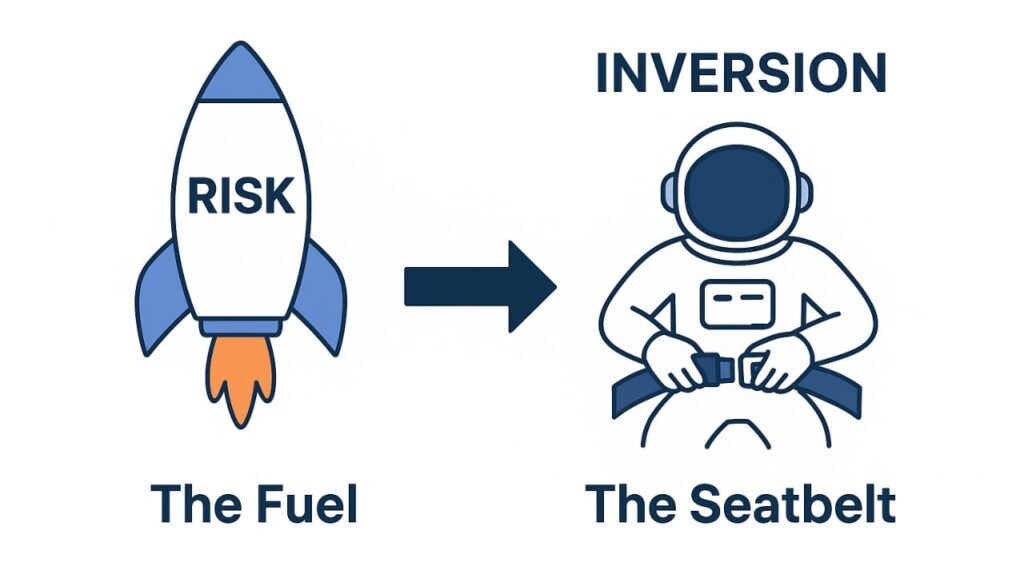
Risk is the engine of growth. You must still have the courage to start the business, launch the product, or make the career change. Inversion should never be used to talk yourself out of these essential, bold leaps.
So, what is its role?
Inversion is the seatbelt, not the brakes.
Once you’ve decided to press the accelerator and take the risk, inversion is what you use to bulletproof your execution. It’s the tool that ensures your bold risk has the highest chance of paying off.
For example:
· The Risk: You decide to start a business. This is good and necessary.
· The Inversion: You then ask, “What are the most common reasons new businesses in my industry fail?” You might identify: poor market research, ignoring customer feedback, and chaotic cash flow management.
· The Result: Instead of just charging ahead blindly, you now have a targeted action plan. You conduct thorough research, build feedback loops, and create a strict budget. You took the risk, but you used inversion to navigate it intelligently.
Inversion for Personal Growth: The Power of “Stepping Aside”
This model isn’t just for projects; it’s incredibly powerful for honest self-reflection. It helps you identify your personal blind spots.
Ask yourself questions like:
· “If I take on this critical task myself, what specific lack of expertise could cause me to fail?”
· “Would my stubbornness to ‘do it all myself’ be the very thing that sinks this project?”
Often, the smartest move inversion reveals isn’t about working harder, but about having the humility to recognize when someone else is better suited for the job. Sometimes, the best way to avoid failure is to step aside and enlist the right help.
The Real Transformation: Moving Forward, But Smarter
Ultimately, Inversion Thinking isn’t a tool for standing still. It’s a tool for moving forward with greater confidence and intelligence.
Here’s what it truly teaches:
· It Illuminates Blind Spots: It forces you to see the hidden obstacles everyone else ignores.
· It Balances Ambition with Awareness: It tempers the excitement of a new goal with a practical, grounded plan.
· It Asks the Necessary Questions: It makes you confront uncomfortable truths early, saving you from pain later.
The real transformation happens when you stop seeing inversion as a way to avoid failure and start seeing it as the key to achieving lasting success. It doesn’t clip your wings; it simply ensures you have a safer, smarter flight plan.
—————————————————————————————————————————
Frequently Asked Questions(FAQs)
Inversion Thinking is a problem-solving technique that involves flipping your perspective to consider the opposite of what you want to achieve. Instead of just asking, “How do I achieve success?” you ask, “What could cause failure?” or “How do I avoid a bad outcome?”.
The core idea is that many hard problems are best solved when addressed backward. This approach helps uncover hidden risks and blind spots that are not obvious when you only think forward. It’s famously championed by investors like Charlie Munger, who advised, “All I want to know is where I’m going to die, so I’ll never go there”. The ancient Stoic philosophers also practiced a form of this, called premeditatio malorum (premeditation of evils), where they envisioned worst-case scenarios to better prepare for and prevent them.
Applying inversion in business is a practical way to de-risk projects and strategies. Here are some powerful techniques:
· Conduct a Pre-Mortem: This is a structured inversion exercise for teams. At the start of a project, gather your team and say: “Imagine it’s one year from now, and our project has failed completely. Tell the story of how it happened.” This technique encourages team members to voice concerns they might otherwise suppress and helps identify potential problems before they occur.
· Ask Inverted Questions: Shift the questions you ask in strategic discussions. For example:
· Instead of “How can we increase sales?” try “What would alienate our core customers and make them stop buying?”
· Instead of “How can we be more innovative?” try “What are we doing that stifles innovation and creativity in our company?”
· Focus on Avoiding Stupidity: Charlie Munger and Warren Buffett’s partnership emphasizes that it’s remarkable how much long-term advantage you can get by trying to be consistently “not stupid” instead of trying to be very intelligent. This means prioritizing the avoidance of critical errors—like unnecessary debt or dysfunctional culture—over making brilliant moves.
· What is the connection between inversion and critical thinking? Inversion is a key tool for critical thinking. It forces you to challenge your own assumptions and combat confirmation bias (the tendency to only seek information that supports your existing beliefs). By seriously considering the opposite viewpoint, you ensure your ideas are more robust and logically sound.
· What are the potential drawbacks of inversion thinking? A primary risk is that constant focus on what could go wrong can lead to excessive negativity, fear, or paralysis by analysis. The key is to use inversion as one tool among many, not the only one. It’s best for identifying and mitigating risks, not for replacing visionary goals and positive action.
· Can I use inversion in my personal life? Absolutely. It’s highly effective for personal development:
· Health: Instead of “How can I get fit?” ask “What are the worst habits for my health?” (e.g., sedentary lifestyle, poor sleep). Avoiding these is the first step.
· Finances: Instead of “How can I get rich?” ask “What behaviors guarantee I’ll stay poor?” (e.g., spending more than you earn, accumulating bad debt). Avoid those behaviors.
· Relationships: To have a good relationship, consider what makes a bad one (e.g., lack of trust, disrespect) and actively avoid those behaviors.